Posts

Showing posts with the label crisis

What's wrong with Malaysia in terms of GDP per Capita? (2012)

Image
Addressing the issue, which Finance Malaysia thinks was critical at a time of globalization heats up, Malaysia needs to formulate and take action immediately without much hesitation. But, before we jump into action, we need to know the root of the problem. Right? Exactly, we must find out the reason why we left behind other countries in terms of GDP per capita , which refers to the country's gross domestic products at purchasing power parity (PPP) per capita. According to Wikipedia, it was the value of all final goods and services produced within a country in a given year divided by the average population for the same year. Why not using nominal GDP to measure national wealth? Comparison of national wealth are also frequently made on the basis of nominal GDP, which does not reflect differences in the cost of living. Using a PPP basis is arguably more useful when comparing generalized differences in living standards on the whole between nations because PPP takes into account the re...
Europe’s Woes Flood Wall Street—But Not the Economy? (May 2012)

Image
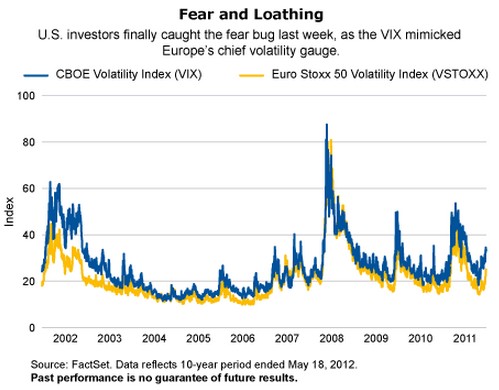
After months of buildup, Europe’s sovereign-debt crisis has finally wreaked havoc on the U.S. stock market, as a wave of anxiety has prompted a major sell-off on Wall Street. We’ve seen a dramatically “risk off” environment with the Dow Jones Industrial Average dropping 3.52% — the biggest one-week decline since November — and the S&P 500 falling 4.3% . Among the hardest hit stocks were small caps and tech, with the Russell 2000 and the Nasdaq Composite falling 5.4% and 5.3%, respectively. To further underscore the risk-off environment, the yield on the 10-year Treasury still appears to be searching for a bottom, finishing at 1.702%, but falling below 1.700% intraday this week — a modern-era low. Spring Swoon? History may not be repeating itself, but it certainly is rhyming. Like the spring of 2010 and the spring of 2011, investors’ fears are coming to fruition and we are once again experiencing a “spring swoon.” Stocks a...

Who can Save GREECE? (Feb 2012)

Image
It's the time again for Greece to convince its counterparts that they are serious in cutting budget deficits. By doing so, Greece was to put on the lifeline (bailout) by European Union (EU) once again. The discussion of whether to save or not to save Greece had been dragging for one week time now. Why? In Chinese, we say "we cannot see people die by not lending our hand". That's why China said they will help when the time arrives. The question is when is the right time? Until Greece go bankrupt? Or,  until Greece left EU? Who can save Greece? The answer to this very important question is very obvious. In Christian, they always emphasize on " we should take responsibilities on what we did ", right? So, the solution lies in Greece hands. Not the country, but, the citizen, the people of Greece. It's time for them to come back to reality. Let's take Malaysia as a benchmark, they are working fewer hours than us, yet they are earning much better than us. G...

Western Debt Crisis: Bursting of Volcano? (Sept 2011)

Image
We cannot deny that we are in for another round of hard times since 2008 global financial crisis. Some experts are saying that we are facing the Great Depression wave coming in the next few months, if no concrete efforts put in by global leaders. Meanwhile, some experts think that opportunities arises again and put off the double-dip recession speculation. The downgrading of US's AAA rating re-ignite the fears over the sustainability of its sovereign debt. However, please be mindful that US rating remains extremely sound and reflecting a very low risk of default in the long term, still. USD remain the preferred and most widely traded currency in the foreseeable future, and there is no reason to worry about. Sovereign Risk scaring investors away? Meanwhile, in Eurozone, the situation remains very complex and greater political will is needed to maintain Euro as regional currency. Between Eurozone breaking up and resolving the situation, which one is easier? Of course, the economic ...

Post-Japan Disaster: After Timber, it's Glove Sector?

Image
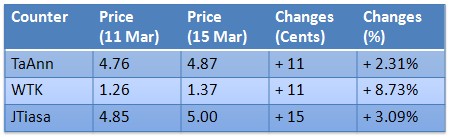
As per our previous posts ( How Should Investors trade after the Japanese Disaster? ), we wrote about timber counters, and it's proven the right sector investors should look at. And, below is the performance of those mentioned counters. www.financemalaysia.blogspot.com All of them outperformed KLCI, which recorded -2.20% . Why WTK outperformed its peers? Simple answer is its cheaper share price and better liquidity. In fact, TaAnn and WTK is the main focus because they export 80-90% of their products to Japan. This puts them in the limelight of stocks investors should look at for the moment. Why should you look at Glove sector next? After timber, glove sector should outperformed the generally weak market sentiment. Investors are scared. Those who already bought was stuck-in there. Those who already sold was staying sidelined. And, those who dare to buy now is focusing on timber stocks only - and today glove. Main reasons were: Demand for medical glove is expected to increase sub...

How far could Oil price RISES?

Image
As usual, another episodes of tension in the Middle East pushes global oil prices higher, and surpassing $100 per barrel this time. We did seen this kind of scenario before in the Middle East during 1973-74, 1979, and the Iraq war in 1990. Are there any different this time? Libyan leader Muammar Qaddafi By Credit Suisse ,  We believe the rise in oil prices is manageable . Each 10% rise in oil prices only takes about 0.1% off global GDP and 0.2% off US growth. With Western wage growth muted, central banks are unlikely to raise rates on account of oil alone. Our analysts see oil prices below $100 pb this year, supported by the following reason which differs from previous oil crisis:- There is enough spare capacity in the global oil market to deal with supply-side disruptions as long as they are not too extreme The energy intensity of global GDP has fallen by around 40% over the past 40 years There is unlikely to be the same inflationary follow-through as in the 1970s Oil producer...

Global Food Crisis, a Repeat of 2008?

Image
KLCI is grappling up for a successful 4 days in a row this week, and perhaps today is the 5th day of record breaking level. However, I am concerned about the health and the sustainability of the market, after reading a report by Food and Agriculture Organization of the United Nations (FAO). And, one of the popular Mandarin Dailies highlighted the potential food crisis as its main topic today. Finance Malaysia did some analysis, and would like to comment on the issue which could be a hot topic for many nations very soon, including Malaysia. In fact, international prices of most agricultural commodities have increased in recent months, some sharply. This has led to a level near to its peak in June 2008. What causing the prices to increased? worsening outlook for crops in key producing countries, which require large draw downs of stocks and result in tighter global supply and demand balances of course, weakening USD, which continues to sustain the prices of nearly all commodities continuo...

Special Coverage: Web of Europe’s Crisis

Image
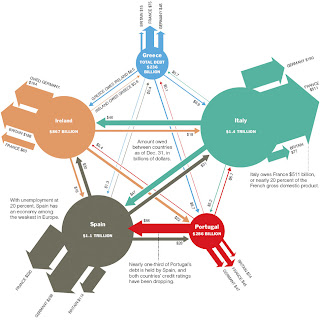
$1 trillion rescue package by European Union. Global share markets reacting positively towards EU latest move. Euro gains 2.7% in one day boosted by EU and IMF. European markets posted best one day gain this year. Sounds GOOD? This is the power of UNITY showed by EU countries during this round of financial meltdown. After a frantic talk on Monday, European officials agreed the 16 euro nations would put up $572 billion in new loans and $78 billion under an existing lending program. Meanwhile, IMF will pump in another $325 billion, adding up to a rescue package of nearly $1 trillion. However, many economists and analysts are still concern as to how the money would be dispensed and on what terms. A lot of them citing the euro rescue won’t solve the main problems plaguing the economies of Greece, Spain, Portugal, Ireland and Italy, which is low growth and weak balance sheets . Let’s enlarge the chart below ( you must ) to have a clear picture of the debt-ridden countries, taken from www....